

Zero Trust is often discussed in the context of user accounts, network segmentation, or cloud security. Those controls matter, but they all assume that the systems doing the communicating and being accessed can themselves be classified as trustworthy. In distributed edge, router, gateway, and Industrial IoT architectures, that question does not start at the network layer. It starts with the identity of the device and with verifiable evidence of its state. Hardware and firmware security do not deliver a complete Zero Trust architecture on their own, but they establish a technical trust anchor on which access control, encrypted communication, and software security can build.
Zero Trust Does Not Start at the Network
A Zero Trust approach assumes that no user, service, or device is automatically trusted based on location or prior connection. Every access decision has to be evaluated in context. In practice, that context includes identities, permissions, network paths, applications, and the security state of the system involved.
The technical trust question, however, is often raised too late. A firewall can control a connection, a segment can limit access, and a cloud service can evaluate logins. None of these measures, on their own, answers whether the connected device is actually the device it claims to be and whether it is running authorized firmware. That is precisely where the hardware and platform layer comes in.
Why Devices Themselves Have to Prove Trust
In a classic, centralized IT environment, systems can usually be classified through directory services, fixed locations, and standardized management processes. At the edge, the picture is more heterogeneous: routers, gateways, edge computers, sensors, and industrial control components sit in many locations, communicate with a wide range of counterparts, and often remain in service for long periods. A connected device is therefore not trustworthy simply because it has reached the right network.
Device identity first answers the question of which system the counterpart is actually communicating with. Technically, this identity can be represented by an individual cryptographic key, a certificate, or a protected device reference. What matters is that the identity is bound to a specific device and that the associated private key cannot easily be read out or copied. Depending on the platform, this is handled by a TPM, a secure element, or other hardware-based protection mechanisms.
As the number of connected systems grows, this distinction becomes more important. When many devices perform similar functions, operate in different locations, and exchange data with each other, general network membership is no longer sufficient as a trust signal. Device authentication helps separate legitimate communication partners from unauthorized or unknown systems. It is an important prerequisite for robust access decisions, but not a complete security architecture in itself. This is especially true for connected devices from the Industrial IoT portfolio, which are deployed across distributed sites and remain in service over long operational lifetimes.
From Hardware Root of Trust to Verified Firmware
Root of Trust, Chain of Trust, Secure Boot, and firmware authenticity are interlocking concepts. They can be understood as a single structure that reaches from a protected anchor in hardware to verified firmware at runtime.
Hardware Root of Trust
A Hardware Root of Trust is, in simple terms, a particularly well-protected trust anchor within a platform. It can store key material, support cryptographic checks, or secure the boot process. The point is not that hardware prevents every possible manipulation, but that it provides a starting point whose properties can be relied on for subsequent checks.
Chain of Trust
A Chain of Trust builds on this starting point. Each already-trusted component verifies the next before it is executed. Simplified, the sequence looks like this:
- Hardware or hardware-based trust anchor
- Firmware and the first boot stage
- Bootloader and operating system
- Applications and, where applicable, additional system components
Each stage can verify the authenticity or integrity of the next. If a signature is invalid, if a component does not come from an authorized source, or if its measured value differs from the expected state, the platform can, depending on the implementation, halt the boot process, switch to a protected mode, or raise an error.
Secure Boot
Secure Boot is one possible element of this chain. At startup, the platform checks whether the boot components about to be executed match a stored or verifiable trust anchor. In many implementations, this is done through digital signatures: firmware or bootloader has been signed by an authorized source, and the device verifies that signature before execution. Secure Boot and signed firmware can detect unauthorized or tampered boot components and prevent them from running. They are not, however, a general-purpose anti-tampering mechanism: they do not automatically protect every application, do not replace access control, and say nothing on their own about whether a device is correctly configured during operation.
Firmware Authenticity and Integrity
Firmware involves two closely related properties. Authenticity means the firmware comes from an authorized source. Integrity means it has not been modified in an undetected way since it was signed. Digital signatures can support both checks: the signature is verified against the public key of the authorized source, and a cryptographic measurement shows whether the file on the device matches the signed state. In a real system, several elements have to work together: a protected trust anchor, a traceable key and certificate management process, defined release workflows, and a platform that actually verifies signatures. Equally relevant is the handling of expired or compromised keys and the ability to revoke versions that are no longer trusted.
These capabilities are not present in every platform by default and may be implemented differently depending on vendor, processor, firmware, and product generation. A simple statement that Secure Boot is "available" is therefore not enough for a technical evaluation. What matters is which components are actually verified, where keys reside, how the trust anchor is protected, and what happens when a check fails.
Device identity and Secure Boot address different questions: device identity answers "which device is this?", while Secure Boot and signature verification answer "which software is allowed to run on this device?". Only in combination do they produce a defensible picture. The same applies between systems: edge devices frequently communicate with routers, gateways, servers, sensors, or cloud services, and the counterpart should also not be accepted on the basis of IP address or location alone. Depending on the architecture, both sides can authenticate each other using certificate-based methods. For hardware selection, the relevant question is whether the platform can securely manage the required keys and reliably support these functions, because verifiable device identity remains the foundation on either side.
Why Hardware Trust Matters Especially at the Edge
Several factors converge at the edge that make early trust verification important: systems sit outside classic data centers, remain in service for long periods, are reached over distributed networks, and are sometimes physically accessible. On top of that come heterogeneous platforms and varying operating conditions. A router, gateway, or edge computer often takes on a central mediating role. If its identity is not cleanly verified, or if unauthorized firmware is allowed to boot, the impact can extend to downstream systems and data flows. This affects, among others, industrial IoT installations, energy infrastructure, transportation systems, manufacturing environments, and other critical infrastructures.
One example is an Industrial IoT gateway that aggregates sensor data from a plant and forwards it to higher-level systems. For a defensible trust decision, encrypting the connection is not enough. The receiving system should also be able to determine whether the gateway belongs to the intended installation and whether it is running in an expected platform state. The more distributed the architecture and the larger the device population, the less tenable the assumption that any already-connected system can be trusted. Hardware-based identity and verification functions provide a verifiable starting point on which both centralized and decentralized security measures can build.
Hardware Security Is the Foundation, Not the Entire Architecture
Hardware Root of Trust, Secure Boot, signed firmware, and device authentication are essential building blocks, but they do not replace a complete Zero Trust architecture. A holistic approach requires additional layers to work together, including access control, network segmentation, and software and cloud security. Hardware does not deliver a finished solution for any of these, but it does provide the technical basis on which those controls can operate more reliably.
Security Begins at System Selection
The question of Zero Trust should be raised during hardware platform selection, not only after commissioning. Relevant criteria for a technical evaluation include:
- Does the platform support Secure Boot, and which boot components are actually verified?
- Is there a TPM, a secure element, or a comparable hardware-based trust anchor?
- How are device identities, certificates, and private keys generated, stored, and protected?
- Can firmware be verified against an authorized source, and how does the system respond to a failed check?
- What options exist for device authentication and secured communication with counterparts?
- Which functions are actually integrated in hardware and firmware, and which have to be provided by additional software or infrastructure?
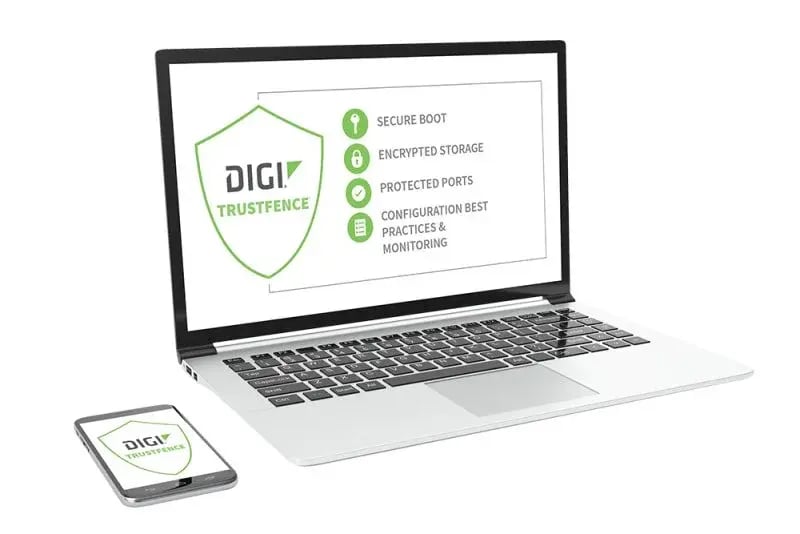
A concrete example of a vendor-side approach is Digi TrustFence®. The framework combines several of the capabilities mentioned above, including Secure Boot and shows how such mechanisms can be implemented in a system context. Which of them apply in a given case depends on the specific device and its configuration. What matters is not the individual label but the fit between platform, security requirements, and overall architecture.
More on Software, Tools, and Services
BRESSNER provides support in selecting and integrating suitable hardware platforms based on project-specific security, interface, and deployment requirements. To do so, we draw on a broad portfolio of manufacturers offering a variety of hardware- and firmware-based security features.
Conclusion: Trust Has to Begin With Evidence
Zero Trust does not begin with a single security feature, but rather with the question of what technical foundation of trust a platform actually provides. That is why device identity and built-in security features should be taken into account as early as the hardware selection phase.
Learn more about Software, Tools, and Services for Industrial IoT at BRESSNER
Share this article


Further posts

Nov 11, 2026, 9:00:02 AM Device identity, hardware root of trust, and secure boot form the technical foundation for Zero Trust in edge, gateway, and Industrial IoT systems.

Nov 4, 2026, 9:00:02 AM How resilient, multi-layered communications architectures secure data flows at the tactical edge and keep Defense Computing missions operational.

Oct 27, 2026, 9:00:02 AM How rugged hardware, Secure Boot, firmware integrity, and lifecycle management shape cyber defense for mission-critical systems at the tactical edge.

Oct 21, 2026, 9:00:01 AM How rugged systems behave under sustained load, thermal stress, and unstable links, and what that means for Defense Computing architectures in the field.

Oct 14, 2026, 9:00:00 AM How Rugged Computing and Tactical Edge architectures turn distributed sensor data into a consistent, mission-ready situational picture in Defense Computing

Oct 7, 2026, 9:00:01 AM Why rugged computing is crucial for defence applications: validation, thermal management and modular systems in mission-critical operations.

Sep 30, 2026, 9:00:01 AM Edge AI for faster situational assessment: How sensor fusion and human-in-the-loop decision support are reducing military response times.

Jun 9, 2026, 9:00:00 AM Industrial hardware for harsh environments: why rugged design, thermal stability, serviceability, and lifecycle matter. Includes the BRESSNER Buyer’s Guide.

Feb 26, 2026, 9:00:00 AM Discover how 5G and Wi-Fi 7 are revolutionizing the reliability and security of industrial networks and setting new standards for digitalization.

Feb 10, 2026, 9:00:00 AM From the sensor to the cloud: How gateways and edge systems optimize data flows in industry—securely, scalably, and efficiently with BRESSNER.

Feb 3, 2026, 9:00:00 AM Learn how Panel PCs are revolutionizing hospital processes and improving critical medical decisions through edge computing.

Want to stay up to date?
- Then sign up for our newsletter!